
What Is the Best Patty Maker Machine from China?
Choosing the best patty maker machine from China requires more than comparing prices and production speeds. The decision affects patty weight, shape, hygiene, labor efficiency, and long-term maintenance. In busy plants, a small weight difference becomes thousands of grams each shift. That is real product loss.
The OECD-FAO Agricultural Outlook 2023–2032 expects global meat consumption to continue growing, although growth rates differ across regions. PMMI industry research also identifies labor shortages and automation as major forces shaping food-processing investment. These trends support demand for reliable forming equipment. Still, a machine’s advertised capacity may not match its performance with chilled beef, sticky blends, or coarse formulations. Buyers should test actual recipes before signing an order.
Temple Grandin, a leading authority on meat-processing systems, has often warned, “There is no magic bullet.” That principle applies to every patty maker machine. The strongest option is not always the fastest model. It should deliver stable portion control, easy cleaning, accessible replacement parts, and documented food-contact materials. Chinese manufacturers offer impressive customization, including servo controls, stainless-steel frames, adjustable moulds, and automatic paper interleaving. Quality varies, however. A polished brochure cannot replace factory trials, inspection records, and customer references.
This guide compares practical specifications, supplier credibility, operating experience, and total ownership cost. It also questions a common assumption: higher output does not automatically mean better value. Sometimes, a simpler machine produces fewer stoppages and better margins.
What Is a Patty Maker Machine and How Does It Work?
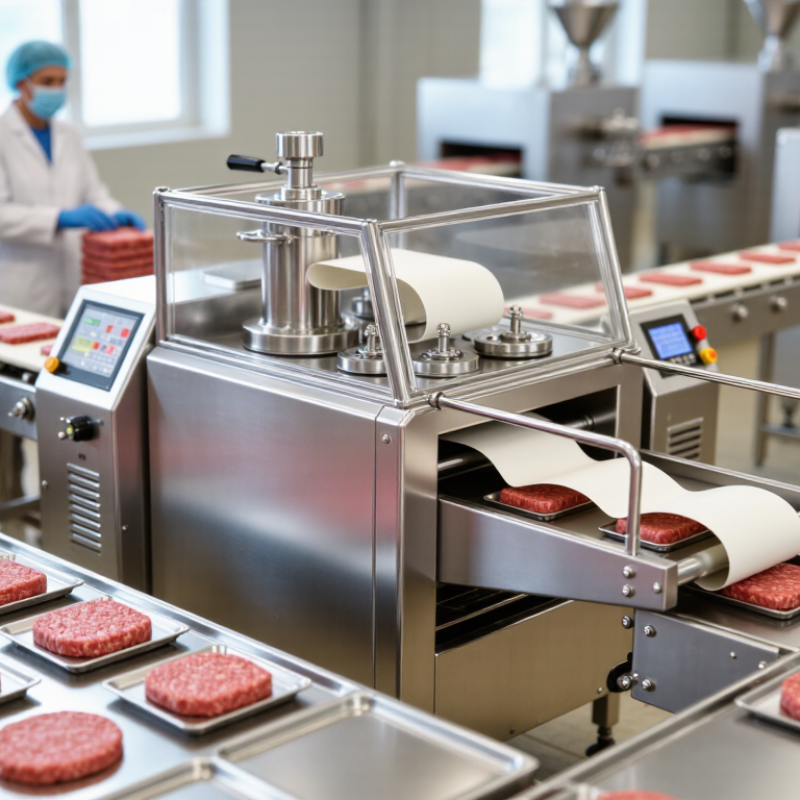
A patty maker machine forms measured portions of ground meat or plant-based mixture into even discs. It usually combines a hopper, portioning chamber, forming plate, and release mechanism. An operator loads chilled mixture into the hopper. A piston or rotary plate presses each portion inside a mold. The mold controls the patty’s diameter, thickness, and weight. Then, a scraper or ejector places it onto paper or a conveyor. Simple process. The machine’s real value is consistency, not merely speed.
When evaluating a patty maker machine from China, inspect food-contact materials, welds, seals, and cleanability. Stainless steel surfaces should resist corrosion and have no sharp corners. Ask for test videos using your actual recipe. Moisture and fat can change release performance. During a practical trial, weigh twenty patties and measure their thickness after cooling. A reliable machine should maintain small weight differences and allow quick adjustments. Check overload protection, emergency stops, clear manuals, and documented electrical specifications. Some machines appear fast on paper. Yet a narrow hopper or difficult mold can slow a real shift. I would also question whether cleaning takes longer than forming. That overlooked detail affects labor, hygiene, and product quality. No machine is perfect. Even a careful trial may reveal compromises after longer operation.
What Is the Best Patty Maker Machine from China? - What Is a Patty Maker Machine and How Does It Work?
| Machine Type | How It Works | Typical Capacity | Common Patty Diameter | Typical Patty Thickness | Power Requirement | Best Use | Key Selection Consideration |
|---|---|---|---|---|---|---|---|
| Manual Press | A measured portion of ground meat is placed into a mold and compressed by a hand-operated lever or plate. | Approximately 80–200 patties per hour, depending on the operator and mold size. | 80–150 mm | 6–25 mm, usually adjustable with spacers or mold settings. | No electricity required. | Home kitchens, small restaurants, food stalls, and low-volume preparation. | Lowest purchase cost, simple maintenance, and consistent portion measurement. |
| Single-Station Automatic Press | Ground meat is loaded into a hopper or forming chamber; a piston or forming plate shapes one patty during each cycle. | Approximately 600–1,200 patties per hour. | 80–130 mm | 5–30 mm, depending on the forming plate and adjustment system. | Commonly 0.4–1.1 kW; verify the local voltage and frequency before purchase. | Restaurants, butcher shops, catering kitchens, and small production rooms. | A practical balance between output, footprint, portion control, and purchase cost. |
| Continuous Automatic Former | A conveyor, rotating drum, or forming plate continuously portions and compresses ground meat into patties. | Approximately 1,500–4,000 patties per hour. | 80–150 mm | 5–30 mm, with machine-dependent adjustment. | Commonly 1.5–4.0 kW, depending on the forming system and accessories. | Central kitchens, institutional food production, and medium-scale processing. | Continuous feeding, stable portion weight, quick changeover, and ease of cleaning. |
| High-Output Forming Line | A hopper, portioning mechanism, forming unit, and conveyor operate as an integrated production line. | Approximately 4,000–10,000+ patties per hour, depending on configuration. | 60–150 mm | 5–35 mm, subject to product and tooling requirements. | Commonly 4–15 kW for the complete line; exact requirements vary significantly. | Large-scale food processing and standardized frozen or chilled patty production. | Automation level, hygienic design, tooling flexibility, line integration, and after-sales technical support. |
| Recommended Contact Materials | Food-contact surfaces should be made from corrosion-resistant materials suitable for repeated washing and sanitation. | Not applicable. | Not applicable. | Not applicable. | Not applicable. | Commercial kitchens and processing environments with strict hygiene requirements. | Prefer food-grade stainless steel for the hopper, forming chamber, guards, and removable components where applicable. |
| Typical Forming Cycle | Portioning, filling, compressing, releasing, and transferring are completed in sequence. | Cycle time may range from about 1 to 6 seconds for single-station equipment. | Determined by the mold or forming drum. | Controlled by compression distance, mold depth, or product settings. | Varies by machine type. | Applications requiring repeatable patty weight and shape. | Check whether the machine maintains shape without excessive compression that can produce a dense texture. |
| Suitable Product Conditions | Ground meat is portioned and compressed while sufficiently chilled to remain cohesive during forming. | Performance depends on formulation and feed consistency. | Varies by recipe and mold. | Varies by recipe and mold. | Not applicable. | Beef, pork, poultry, fish, and selected plant-based mixtures, subject to machine testing. | Request a product trial when using sticky, high-moisture, coarse-ground, or plant-based mixtures. |
| Best Overall Choice for Most Small Businesses | A single-station automatic press generally offers automated portioning and forming without the space and cost of a full production line. | Approximately 600–1,200 patties per hour. | 80–130 mm | 5–30 mm | Often 0.4–1.1 kW, subject to the selected model. | Restaurants, butcher shops, catering operations, and growing food businesses. | Choose adjustable thickness, removable food-contact parts, easy sanitation, overload protection, and local electrical compatibility. |
Operating principle: A patty maker portions ground ingredients, compresses them inside a mold or forming chamber, releases the shaped patty, and transfers it for packaging, cooking, chilling, or freezing. Capacity figures are typical working ranges rather than guaranteed production rates.
Related Posts
-

Top 10 Meatball Maker Machines You Need to Try Today?
-
What Is the Best Automatic Packaging Machine in 2026?
-
How to Choose the Best Fruit Sorting Machine for Your Business?
-
What is a Cane Juice Machine and How Does It Work for Your Business
-
How to Choose the Best Sugarcane Machine in 2026?
-
Top Tips for Choosing an Automatic Packing Machine?