7 Tips to Choose the Best Sugarcane Juice Machine
Choosing the right sugarcane juice machine can shape your daily workflow, drink quality, and operating costs. A machine may look powerful in a product photo, yet perform poorly during a busy afternoon. Real experience shows that small details matter, including roller alignment, juice yield, noise, cleaning time, and waste control.
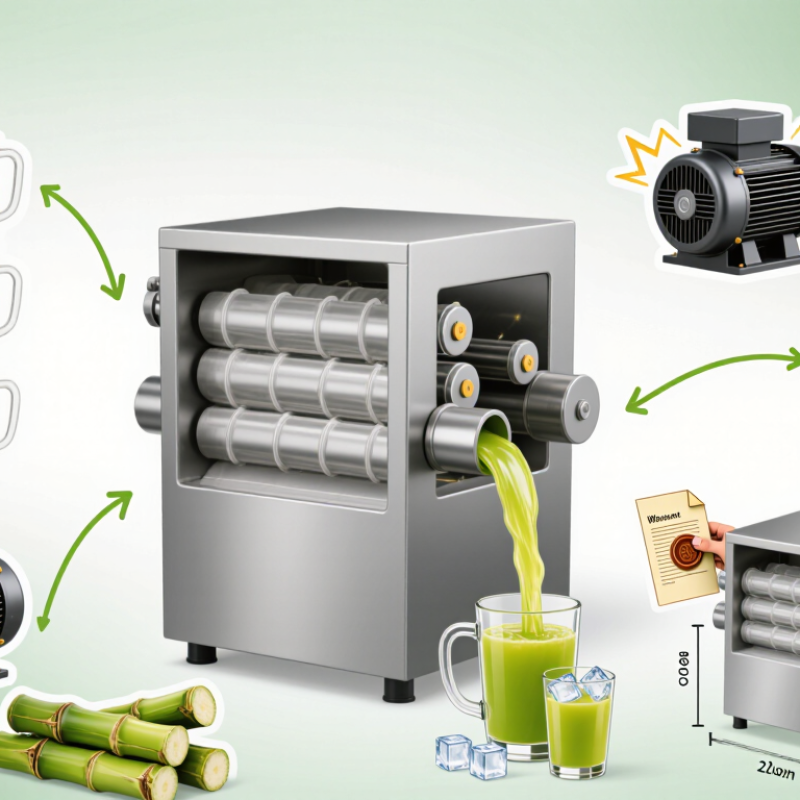
This guide explains seven practical tips for making a more confident choice. It considers machine capacity, motor strength, food-contact materials, safety features, maintenance, warranty support, and available space. Stainless steel surfaces are easier to inspect and clean. Strong rollers should crush cane evenly without excessive vibration. A reliable motor should handle repeated use without overheating. Do not trust impressive specifications alone. Ask how those figures were measured.
Think about your actual workload.
A small café may need a compact model, while a roadside juice stand may require continuous crushing power. Easy disassembly can save several minutes after every service period. That time becomes significant over a month. Hygiene also deserves careful attention, especially around juice channels, filters, and hidden corners. Manufacturer guidance and verified customer feedback can reveal problems that advertisements omit.
No sugarcane juice machine is perfect. Some efficient models are expensive, and affordable units may require more hands-on maintenance. My recommendation could change after testing a machine under your conditions. Careful comparison remains essential. By examining these seven areas, you can reduce guesswork and choose equipment that supports consistent, safe, and profitable juice preparation.
Define Demand First: Compare Machines Rated at 100–300 L/h
7 Tips to Choose the Best Sugarcane Juice Machine
Define demand before comparing machines rated at 100–300 L/h. A 100 L/h model delivers about 1.7 liters per minute, while a 300 L/h model reaches 5 liters. That difference matters during lunch queues, festivals, and hot-weather sales. FAOSTAT reports that global sugarcane production exceeded 1.8 billion tonnes in 2022, showing the crop’s enormous commercial scale. However, a large market does not automatically justify a larger machine.
Estimate sales by hour, not by daily guesses. If you expect 80 liters during a busy hour, a 100 L/h machine may work, but cleaning and loading reduce its practical output. A 300 L/h unit suits heavier traffic, though it may waste power and counter space in a quiet shop. USDA’s Sugar: World Markets and Trade report forecast global sugar production at roughly 186 million metric tons for 2024/25. Demand is substantial, but local foot traffic still controls your purchase.
Check cane diameter, operator speed, extraction yield, and recovery time. Ask for a live test using your typical cane, not ideal samples. A neat spreadsheet can still mislead. The rated capacity is rarely the serving capacity. Leave a buffer of 20–30% for pauses, jams, and cleaning. This is not perfect. Your first estimate may be wrong, so record actual hourly orders for one week before choosing between 100, 200, and 300 L/h.
Prioritize Food Safety: Require 304 Stainless Steel and HACCP Support
7 Tips to Choose the Best Sugarcane Juice Machine
Prioritize Food Safety: Require 304 Stainless Steel and HACCP Support
Fresh sugarcane juice looks simple, but its safety depends on every contact surface. The World Health Organization estimates that contaminated food causes about 600 million illnesses yearly. A machine can increase that risk when juice, pulp, and moisture remain trapped. Choose 304 stainless steel for rollers, juice channels, trays, and fasteners. Confirm the grade with material certificates. Shiny metal is not proof. A polished surface can still hide poor welds, sharp corners, or dead zones.
Tip 1: Inspect every food-contact area by hand. Surfaces should feel smooth and easy to reach.
Tip 2: Request HACCP documentation, including hazard analysis, critical control points, cleaning procedures, and corrective actions. HACCP support is practical, not decorative paperwork.
Tip 3: Check whether rollers and screens can be removed without special tools. Faster disassembly usually improves daily cleaning.
Tip 4: Ask for cleaning validation records. The FDA Food Code requires food-contact surfaces to be corrosion-resistant, smooth, and cleanable. Local requirements may differ.
Tip 5: Examine seals and drain paths. Standing juice invites microbial growth.
Tip 6: Verify temperature and storage guidance for fresh juice. The machine cannot control every handling mistake.
Tip 7: Request operator training and traceability records. Even good equipment fails when routines are vague. This is easy to underestimate. Schedule a trial cleaning before purchase, then reconsider any part that remains wet, sticky, or difficult to inspect.
7 Tips to Choose the Best Sugarcane Juice Machine: Prioritize Food Safety
Food-contact equipment should use verifiable materials and documented hygiene controls.
Type 304 stainless steel typically contains 18–20% chromium, 8–10.5% nickel, and no more than 0.08% carbon by weight.
When selecting a sugarcane juice machine, request material certificates, smooth and cleanable contact surfaces, and HACCP-based food-safety documentation.
Match Power to Output: Evaluate Motors Across the 1.5–3 kW Range
7 Tips to Choose the Best Sugarcane Juice Machine
Match Power to Output: Evaluate Motors Across the 1.5–3 kW Range
Motor power should match real production, not an attractive specification sheet.
A 1.5 kW motor may suit a small stall serving occasional cups. A 2.2 kW unit can provide stronger roller torque during steady service. A 3 kW motor is more appropriate for longer shifts and heavier cane loads. However, higher power does not automatically mean better extraction. Roller design, shaft speed, and pressure matter equally.
Check seven practical points:
rated power, continuous-duty rating, starting torque, thermal protection, speed control, noise, and measured output. The U.S. Department of Energy’s Motor Systems Market Assessment identifies motor-driven equipment as responsible for roughly 69% of industrial electricity consumption. Efficiency deserves attention. The European Commission’s ecodesign framework also emphasizes minimum motor efficiency classes, especially for equipment operating many hours daily. Electricity losses become visible on monthly bills.
Test the machine with mature and fibrous stalks.
Measure cups per hour, juice yield, motor temperature, and recovery time between loads. A short demonstration can mislead. One wet stalk may stop a weak roller. A 3 kW motor may still waste energy if the gearbox is poorly matched. I would leave a safety margin, but not an oversized motor without evidence. The judgment is imperfect; local cane quality changes everything. Ask for operating data under realistic loads, then compare output per kilowatt-hour.
Compare Ownership Costs: Review Energy Use, Warranty, and Spare Parts
Choosing the best sugarcane juice machine requires more than comparing its purchase price. I once underestimated electricity costs because the machine looked efficient on paper. Check the motor’s wattage, expected daily operating hours, and local electricity rate. A machine using 1.5 kilowatts for six hours daily can add a noticeable monthly expense.
Ask for a realistic energy estimate. Test the machine during peak service, not only when it runs empty. Noise, heat, and slow crushing may reveal inefficient operation. Keep recent power bills and maintenance invoices. These records help compare ownership costs honestly. Small savings matter.
Warranty terms deserve careful reading. Confirm coverage for the motor, rollers, electrical controls, and labor. A short warranty may indicate higher long-term risk. Check whether transport costs or improper cleaning cancel protection. Spare parts are equally important. Request prices and availability for rollers, belts, filters, switches, and seals. Parts should have clear specifications, not vague descriptions. Delayed delivery can stop sales for days. That loss may exceed the part’s price.
A local service technician can inspect the machine before purchase. Their opinion is often more useful than polished sales claims. Still, one inspection is not perfect. Maintenance habits, juice volume, and water quality can change actual costs. Leave room for those variables when comparing machines.